
Before You Promote Anything: Get Your Listing Right
Every channel you use will funnel people back to your event listing. If the listing is weak, your conversion rate will be too, regardless of how well you promote.
A strong listing has a specific, descriptive title; a description that answers who this is for and what the experience actually feels like; high-quality images that show the vibe; and the price, time, and location visible without scrolling. Get this right first. Then promote.
Stream One: Organic Promotion
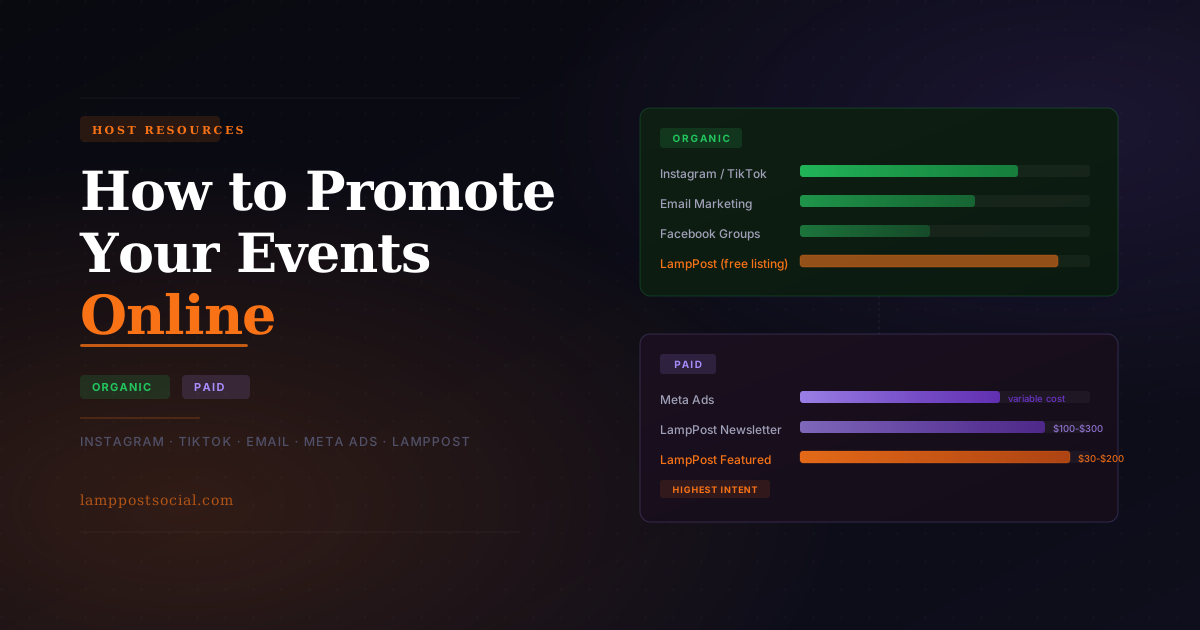
Organic promotion costs time, not money. It's slower to build but pays compounding dividends over time. Every follower you earn, every email subscriber you add, every community you become part of, makes the next event easier to sell out than the last.
Instagram and TikTok
Organic social is the highest-effort channel in this list, but it's also the one that builds something lasting: an audience that follows you between events, not just buys a ticket and disappears.
Instagram rewards consistency and visual quality. The formats that work best for event promotion:
Reels showing behind-the-scenes content. Setup footage, soundchecks, venue walkthroughs, and candid prep moments consistently outperform polished graphics. People want a preview, not an ad.
Stories with countdown stickers. Instagram's countdown sticker creates urgency and lets followers subscribe to a reminder. Use it 7 days out, then again 48 hours before the event. It takes two minutes to set up and reliably drives last-minute purchases.
Carousels for lineup or detail-heavy posts. If your event has multiple things to highlight, a carousel keeps people swiping and signals to the algorithm that the post is worth showing further.
TikTok
TikTok's discovery algorithm is one of the few organic channels that can still reach people who don't follow you. A single well-performing video can put your event in front of thousands of people in your city overnight.
What works: authentic, slightly rough phone videos. "Come with me to set up for tonight's event" style content outperforms anything that looks produced. Keep it under 45 seconds, include your city name and event type in the caption, and show your face. The algorithm uses audio and text cues to serve your video to a local audience.
The honest limitation
Organic social is a long game. If you're running your first event or have a small following, don't expect Instagram or TikTok alone to fill seats. These channels compound over time; they're not a reliable short-term sales lever for a new host.
Local Facebook Groups
Facebook Groups are underrated for local event promotion, particularly for community-oriented or niche events. The audiences inside them are often more engaged than anything you'll find on a public Page, and the discovery is genuinely local.
Search for groups using terms like "[Your City] events", "[Your City] things to do", and "[Your City] [relevant interest]". Read the rules before posting; most groups have self-promotion guidelines. The most effective framing is a community recommendation rather than an ad: "Hosting a jazz night in [neighbourhood] this Saturday for anyone looking for something different" reads better than "BUY TICKETS."
Include the essentials in the post itself: date, time, location, price, and a link. The faster someone can decide whether it's relevant to them, the better your response rate.
Email Marketing
Email is the most underused channel in most hosts' arsenals. People who've already attended your events are dramatically more likely to come to the next one than a cold audience anywhere else online; and email puts you in their inbox without competing with an algorithm.
A simple three-email sequence works well for most events:
Email 1: Announcement (3-4 weeks out). What's happening, why it's worth attending, and a clear link to tickets. Keep it short.
Email 2: Value add (1-2 weeks out). A spotlight on the lineup, a photo from a previous event, or a short testimonial. Warm the idea of attending without just repeating email one.
Email 3: Last chance (48-72 hours out). Be direct. Tickets are running low, the event is almost here, now is the time. Subject lines with urgency work well here: "Doors open Friday, are you in?"
A healthy open rate for event promotion emails to a warm list sits between 30-45%. If you're below 20%, the issue is usually the subject line or the list has gone cold.
LampPost: Organic Discovery
LampPost belongs in your organic strategy because listing your event is free, and it puts you in front of an audience that's actively looking for things to do, not passively scrolling.
The distinction matters. A person browsing LampPost on a Thursday evening is asking a specific question: "What's on this weekend that's worth my time?" When your event appears in that context, you're not interrupting them with content they didn't ask for. You're answering a question they're already asking. That intent-driven discovery converts at a higher rate than social media, even when social drives more raw traffic volume.
Your LampPost listing is also your ticketing page. Through the Bloom Tickets integration, attendees can purchase directly on the platform without being sent elsewhere. Every additional redirect between discovery and checkout loses a percentage of buyers; removing that step is a meaningful conversion advantage.
Used as your anchor link across all other organic channels, your LampPost listing keeps your ticket sales, attendee data, and event management in one place regardless of where people find you first.
Stream Two: Paid Promotion
Paid promotion buys reach and speed. It's the right lever when you need to get in front of people who don't already know you exist, and when you need it to happen quickly. The key is understanding what you're actually buying on each platform, and what you're giving up.
Meta Ads: Facebook and Instagram Advertising
Meta's advertising platform is the most widely used paid channel for event promotion, and it can work well. But it comes with a set of trade-offs that are worth understanding before you put money into it.
What Meta does well
Meta's targeting capabilities are genuinely powerful. You can target by location, age, interests, and behaviour, and you can upload past attendee email lists to create Custom Audiences and Lookalike Audiences that find people who behave similarly to your existing buyers. For reaching a cold audience at scale, it's hard to match.
The real limitations
You're paying for attention, not intent. The people Meta serves your ad to are not looking for an event. They're scrolling through a feed and your ad interrupts them. Some will be interested; most won't. The platform is optimising for clicks and impressions, not for the specific intent that drives ticket purchases.
Costs are variable and unpredictable. Meta's ad auction means your cost per result shifts constantly depending on competition, season, and platform demand. What costs $0.80 per click one week might cost $2.40 the next. Budgeting is genuinely difficult, especially for smaller hosts running occasional events.
The learning curve is steep. Running Meta ads well requires understanding campaign objectives, ad sets, creative testing, pixel tracking, and budget pacing. Boosting a post is not a strategy; it's one of the lowest-return ways to spend ad money on the platform. Hosts who get real value from Meta ads are those who've invested serious time learning the platform, or hired someone who has.
Ad fatigue hits fast for local audiences. If you're targeting a 20km radius in a mid-sized city, you're likely reaching the same pool of people repeatedly. Creative needs to rotate often or frequency climbs, performance drops, and your cost per result rises.
How to run Meta ads if you use them
Choose Traffic or Conversions as your objective, not Engagement. Set your radius to a realistic distance people would travel for your event type. Layer two or three interest categories relevant to your audience. Start with $5-15 per day, 10-14 days before the event, and increase spend in the final 3-5 days when purchase intent peaks. Kill underperforming ad sets early rather than waiting for them to improve on their own.
LampPost: Paid Placement
LampPost's paid options solve the core problem with Meta ads: the audience is already there for the right reason. Every person you reach through a LampPost paid placement is actively browsing local events, not being interrupted mid-scroll.
There are two types of paid placement available:
Newsletter Sponsorship
LampPost sends a twice-weekly newsletter to subscribers across its cities. Sponsored slots in the newsletter put your event directly in the inbox of an engaged local audience that has opted in specifically for event recommendations.
Placement tiers are fixed and transparent:
| Placement | Price |
|---|---|
| Top slot | $300 |
| Mid slot | $200 |
| Lower slot | $100 |
No bid auctions. No variable CPCs. No ad spend that quietly disappears into impressions that never convert. You know exactly what you're paying before you commit.
Website and App Featured Placement
Featured placement puts your event at the top of LampPost's website and app listings, ahead of organic results, for the duration of your booking.
| Format | Price |
|---|---|
| Weekly rate | $200/week |
| Day rate | $30/day |
The day rate is particularly useful for a final push in the 24-48 hours before an event, when local browsing intent is at its highest.
LampPost paid vs. Meta paid: the honest comparison
| Meta Ads | LampPost Paid | |
|---|---|---|
| Audience intent | Low (passive scroll) | High (actively browsing events) |
| Pricing model | Variable, auction-based | Fixed, transparent |
| Minimum effective spend | $100+ (testing required) | $30 (day rate) |
| Setup complexity | High | Low |
| Audience fit | Broad, interest-based | Local event-seekers by definition |
| Learning curve | Significant | None |
Meta is a more powerful targeting machine in the abstract. LampPost delivers a smaller but far more qualified audience, without requiring ad management skills, a pixel, or a testing budget. For most local event hosts, particularly those earlier in their journey, LampPost's paid placements offer a better return on a limited budget. Meta ads make more sense once you have the data, creative, and experience to run them effectively.
Putting It Together: A Promotion Timeline
Here's how both streams fit across a standard 3-week window:
3 weeks out - Publish your LampPost listing (free; your organic anchor) - Send announcement email to your list - Post announcement on Instagram and TikTok - Share in 2-3 relevant Facebook groups
2 weeks out - Book LampPost newsletter sponsorship if budget allows - Post a behind-the-scenes or lineup update on social - Send a value-add email
1 week out - Launch Meta ads if using ($5-15/day) OR book LampPost weekly website placement - Countdown Story on Instagram - Post again in Facebook groups with updated ticket availability
48-72 hours out - Final "last chance" email - Add LampPost day rate placement if seats remain - Stories countdown on Instagram - Check Meta ad performance if running; pause underperforming creatives
Day of - Post from the venue - Go live briefly on Instagram or TikTok if possible - Remind followers via Stories
The Bottom Line
You don't need to be everywhere. A focused strategy across a few well-used channels will outperform a scattered effort across all of them. Start with your LampPost listing as the foundation, build organic social for long-term audience growth, use email to convert the warm audience you already have, and use paid promotion to accelerate reach when it counts.
The choice between Meta ads and LampPost paid placements comes down to where you are as a host. If you're still building your audience and want a straightforward, low-risk paid option that reaches people already looking for local events, LampPost's fixed placements are the cleaner starting point. Meta becomes more powerful as you accumulate data, creative learnings, and a retargetable audience. Both have a place; the question is which one makes sense for where you are right now.
Ready to list your next event? Get started on LampPost →