

The Core Difference: Interruption vs. Discovery
Before getting into numbers, it's worth understanding what you're actually buying on each platform.
When you run a Meta ad, you're buying an interruption. The person who sees your ad was not looking for an event. They were scrolling through their feed, and your ad appeared between a post from their cousin and a video of a dog. Some of those people will be interested. Most won't. Meta's algorithm does its best to show your ad to people who are statistically likely to click, but the intent behind that click is passive at best.
When someone is browsing LampPost, they've already made a decision: they're looking for something to do. They've opened an app or a website with a specific question in mind: "What's happening in my city this weekend?" Your event appearing in that context is not an interruption; it's an answer. That shift in intent sounds subtle, but it's the single biggest factor in how efficiently your marketing budget converts into ticket sales.
Everything else in this comparison flows from that core distinction.
Cost: What You're Actually Paying For
Meta Ads
Meta's pricing is auction-based, which means your costs fluctuate depending on how many other advertisers are competing for the same audience at the same time. A campaign that costs $0.80 per click in February might cost $2.50 per click in December when every retailer and events company is running Christmas campaigns simultaneously.
For a local event host, realistic Meta ad costs look something like this:
- Cost per click (traffic campaign): $0.80 to $3.00+ depending on audience size, creative quality, and season
- Cost per purchase (conversion campaign): $8 to $40+ per ticket sold, depending on your ticket price and how well your campaign is optimised
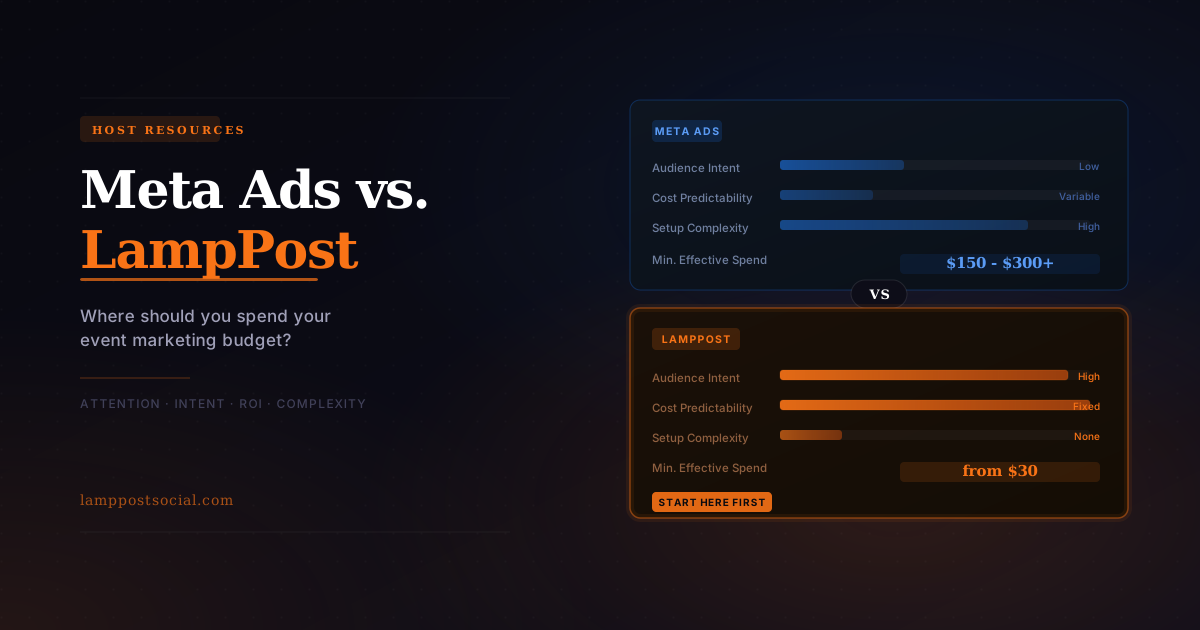
- Minimum meaningful budget: Most media buyers will tell you that $5/day produces so little data that optimisation is nearly impossible. A realistic testing budget for a local event campaign is $150 to $300, and that's before you've found a creative and targeting combination that actually works
There are also hidden costs that don't show up in your ad spend. Learning the platform properly takes significant time. If you're paying someone to manage your campaigns, add that to the total. If you're doing it yourself and getting it wrong, you're paying in both money and opportunity cost.
LampPost
LampPost's paid placements are priced simply and transparently:
Newsletter sponsorship (twice-weekly, sent directly to local event-seekers):
| Placement | Price |
|---|---|
| Top slot | $300 |
| Mid slot | $200 |
| Lower slot | $100 |
Website and app featured placement (your event pinned at the top of local listings):
| Format | Price |
|---|---|
| Weekly featured | $200 |
| Daily featured | $30 |
There is no auction. There is no testing budget. There is no learning period. You pay a fixed price, your event appears in front of people actively looking for events, and you know exactly what you spent.
Audience Quality: Who You're Actually Reaching
Meta Ads
Meta's targeting is genuinely sophisticated. You can narrow by location, age range, interests, and behaviours, and you can build Custom Audiences from past attendee email lists and Lookalike Audiences that find people who resemble your existing buyers. For a national brand or a large recurring event, this is powerful.
For a local event host, though, the pool is smaller than it appears. A 20km radius around a mid-sized city might contain 200,000 people on paper. But strip out age ranges that don't fit your event, apply interest filters, account for people who've already been served your ad repeatedly, and that number shrinks fast. Local campaigns suffer from audience fatigue more quickly than national ones, and when frequency climbs, performance drops and cost per result rises.
The other limitation is that interest-based targeting is an approximation. Someone who liked a jazz page three years ago is not the same as someone actively looking for a live jazz event this Saturday night. Meta is matching demographics and past signals; it can't see current intent.
LampPost
LampPost's audience is self-selected by intent. Every person on the platform is there because they want to find local events. You don't need to infer interest from historical behaviour; it's demonstrated by the act of opening the app.
The newsletter audience is even higher quality. These are people who've opted in to receive curated local event recommendations directly in their inbox, twice a week. They're not passive browsers; they're active event-goers who've said: "Tell me what's worth attending."
The audience is smaller than Meta's potential reach. That's a genuine trade-off worth acknowledging. But a smaller audience with higher intent will almost always outperform a larger audience with lower intent, particularly at the ticket price points most local events operate at.
Spend Scenarios: What $100, $200, and $500 Actually Gets You
Scenario 1: $100 budget
On Meta: $100 over 7 days is roughly $14/day. At a realistic cost per click of $1.50 for a local campaign, you're buying around 65-70 clicks to your ticket page. If your listing converts at 5% (a reasonable benchmark for a cold audience), that's 3 to 4 ticket sales. You'll have spent your entire budget before you've collected enough data to meaningfully optimise the campaign.
On LampPost: $100 buys the lower newsletter slot in one edition, reaching engaged local event-seekers directly in their inbox. Alternatively, $30/day buys three days of featured placement on the website and app. No setup time, no creative testing, and every person you reach was already looking for something to do.
Verdict at $100: LampPost. Meta's minimum effective spend is higher than this; $100 doesn't give you the runway to learn and optimise. LampPost's day rate and lower newsletter slot are designed for exactly this budget.
Scenario 2: $200 budget
On Meta: $200 gives you more room to work with but still represents an early-stage campaign for most local audiences. You might run two or three ad sets with different creative to start identifying what performs, but you'll likely spend much of the budget in the learning phase before the algorithm has enough data to optimise effectively. Realistically, you're buying 130 to 250 clicks and perhaps 6 to 12 ticket sales, with significant variance.
On LampPost: $200 buys a full week of featured placement on the website and app, putting your event at the top of local listings for 7 days. Or it buys the mid-slot in one newsletter edition. Either way, you're reaching a warm, intent-driven audience with zero setup time and a completely predictable cost.
Verdict at $200: LampPost, particularly for hosts without existing Meta campaign data. If you've run previous campaigns and have a proven creative and a Lookalike Audience built from past attendees, Meta becomes competitive here. Without that, LampPost delivers more predictable value.
Scenario 3: $500 budget
On Meta: At $500, you have enough budget to run a proper campaign: $35 to $50/day over 10-14 days, with multiple ad sets, creative variants, and enough data to make meaningful optimisation decisions. A well-run campaign at this budget with good creative and a targeted local audience can realistically drive 20 to 40 ticket sales, depending on ticket price and conversion rate. This is where Meta starts to show its strength, particularly if you can retarget people who visited your ticket page but didn't convert.
On LampPost: $500 covers the top newsletter slot ($300) plus a week of featured app placement ($200), giving you a combined push across both channels simultaneously. Your event leads the inbox for one edition and tops the local listings for a full week.
Verdict at $500: Both, used together. The LampPost placements give you immediate, intent-driven reach with no waste. The remainder on Meta, if you have campaign experience and a good creative, extends your reach to a cold audience. At this budget, running both in parallel is stronger than going all-in on either.
Complexity: What It Actually Takes to Run Each
Meta Ads
Running Meta ads well is a skill that takes time to develop. You need to understand:
- Campaign objectives and which one to use for event ticket sales
- Ad set structure, audience targeting, and how to avoid overlap
- Creative formats, aspect ratios, and Meta's text-to-image guidelines
- Budget pacing and when to scale or kill ad sets
- Pixel installation to track conversions on your ticketing page
- How to read the Ads Manager dashboard and identify what the data is telling you
Most hosts who "tried Meta ads and they didn't work" were boosting posts rather than running structured campaigns. Boosting is Meta's simplified interface for people who don't want to use Ads Manager; it's also consistently the most expensive way to get the least value from the platform. If you're going to spend on Meta, learn Ads Manager properly or pay someone who already has.
LampPost
Book a placement, submit your event details and creative, and you're done. There's no campaign structure to build, no audiences to define, no pixel to install, and no dashboard to monitor for underperforming ad sets. The entire process takes minutes, not hours, and the outcome is entirely predictable before you spend a cent.
For hosts who are time-poor or early in their marketing journey, that simplicity has real value that doesn't show up in a direct cost comparison.
When Meta Makes More Sense
To be fair: there are scenarios where Meta is the stronger choice.
You have an established pixel and past campaign data. If you've run events before, collected attendee emails, and built a Lookalike Audience, your Meta campaigns will perform significantly better than a host starting from scratch. The data compounds over time, and experienced Meta advertisers get meaningfully better results than beginners.
You're selling a large-scale or ticketed event above $50. At higher price points, the higher cost per acquisition on Meta is more justifiable, and the platform's scale becomes an asset. A $150 ticket event with a $40 cost per acquisition is still a strong return.
You have strong creative and a tested offer. Meta rewards great creative disproportionately. If you've found a video format or ad style that converts consistently, Meta's distribution can scale it efficiently.
You want to reach people outside LampPost's current user base. LampPost's audience is growing, but Meta reaches a larger total pool. If you've already captured most of LampPost's local audience and need to extend further, Meta's scale is useful.
The Honest Summary
Neither platform is universally better. They solve different problems.
Meta is a powerful reach machine that rewards experience, data, and great creative. The more of those three things you have, the better it performs. Without them, it's an expensive way to learn by trial and error on a deadline.
LampPost is a focused, intent-driven channel that delivers a smaller but more qualified audience at a predictable, transparent cost. It requires no learning curve and no testing budget. It's particularly strong for hosts who are earlier in their marketing journey, working with tighter budgets, or who want a reliable baseline of local visibility without the overhead of running paid social campaigns.
For most local event hosts, the right answer is LampPost first, Meta later. Establish your presence in front of the audience that's already looking for events, build your attendee list and pixel data from that foundation, and layer in Meta campaigns as your data and budget grow. Trying to do it the other way around, cold Meta campaigns before you have any campaign history, is the most common and most expensive mistake hosts make with their marketing budget.
Ready to get your event in front of local audiences who are already looking? List your event on LampPost →