.png&w=3840&q=75)
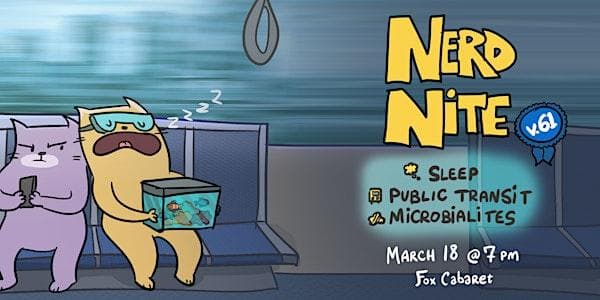
Nerd Nite v61: Sleep, Public Transit, and Fresh Water Microbialites
Thursday, March 19, 2026
9:30pm
Fox Cabaret Vancouver
Genres
Learning & WorkshopsTech & Networking
Tickets0 interested
Event Description
Nerdy Science Lecture series continues!
Join us in the Nerd Den for an evening of fun talks about quirky science topics. We'll dive into the mysteries of sleep, explore the ins and outs of public transit, and uncover the cool world of fresh water microbialites. Perfect for curious minds looking to learn and laugh!
Our charity this month as chosen by our first speaker Rackeb is Black in Neuro. Their mission is to diversify the neurosciences by building a community that celebrates and empowers Black scholars and professionals in neuroscience-related fields.
We also have a special show at the H.R. MacMillan Space Centre with a special talk on Spock, as well as an interactive video game concert from Extra Lives from L.A. A few tickets are still available!
The Rhythm of the Night - Rackeb Tesfaye
Why do some people sleep better than others? Understanding sleep — and what “good sleep” really means — is like navigating a scientific labyrinth, because sleep is interconnected with many biological, psychological, social, and environmental factors. Researchers are piecing together these puzzle pieces to better understand the diversity of sleep experiences and potentially improve the diagnosis and treatment of sleep problems. This talk explores how our circadian rhythms — the body’s internal clock — and the genes that regulate them influence sleep, how sleep varies across populations, and where the future of sleep research, including personalized sleep profiles, is headed.
Dr. Rackeb Tesfaye is an award-winning scientist and science communicator. She earned her PhD in Neuroscience from McGill University, where her research focused on biological, social, and behavioural factors contributing to sleep problems in autistic youth. Her recent work with colleagues explores approaches to uncovering individualized sleep profiles to help inform more precise diagnoses and personalized treatments. Dr. Tesfaye is a strong advocate for patient- and community-oriented research, ensuring that the experiences and expertise of those most affected directly shape scientific research. For more than a decade, she has also championed accessible and inclusive science communication, including as a lecturer, a science columnist for CBC Radio, and a co-founder of initiatives such as ComSciCon Canada and BlackInNeuro.
Transit - Denis Agar
If you've travelled to other cities, you may have noticed that what's considered a "normal" way to get around varies wildly. In Dallas, it's cars. In Nairobi, it's matatus. In Venice, it's vaporetti. But in each place, narratives emerge that retroactively explain why it couldn't be any other way. Transportation infrastructure becomes encoded into the city's culture in a way that feels indelible. But can it change? Denis Agar's entire job is bringing around that change here in Metro Vancouver, and he's bursting to tell you about how those changes have happened elsewhere, and how they can happen here. We'll talk about how Amsterdam used to be a car-clogged deathscape, how suburban Brampton, ON has become one of North America's transit superstars, and how neighbouring Vaughan, ON remains a laggard, despite having the notable advantage of a subway. And much much more.
Bio: Denis Agar (he/him) used to draw freeway interchanges in the margins of his notebooks and once put up a network of street signs in his backyard. He eventually figured out that transportation was some kind of calling and that public transit helps to solve almost every public policy problem we have. He got a planning degree and then worked at TransLink for 10 years where he helped launch the first five RapidBus routes. In 2023, he quit because he could see that Metro Vancouver was missing an independent group that advocates for better public transit. He got together with a few other transit nerds to start Movement: Metro Vancouver Transit Riders, and he is now the Executive Director.
Human Exploration in Deep Space and the Pavilion Lake Research Project - Donnie Reid
Extreme environments, such as space, present unique problems for the astronaut/scientist to work in. Not only is the scientist insulated from their environment, they are isolated from it as well. Deep space, also, adds the issue of latency in communications to these other problems. The Pavilion Lake Research Project (a NASA astrobiology project) studied a small lake in the BC Interior; developing biosignatures, protocols and the training for the searching for life on Mars and other off-world bodies. Suspended on the bottom of Pavilion Lake are the "fresh water corals"; these are really microbial structures; structures that open a window to Earth's ancient past and to possible life on other planets. Presently, NASA has been exploring the lake with underwater robots, SCUBA divers and Nuytco's DeepWorker submersibles.
Bio: Donnie Reid
Donnie Reid has been a SCUBA diver for 40plus years. During much of that time he has been intimately involved in the BC dive industry holding such positions as Director in the Underwater Council of BC, President of the Dive Industry Association of BC, Diving Safety Officer for the Vancouver Aquarium and lead for the last two Ocean Pioneer Award’s Dinners. Through his photography he became involved in numerous expeditions and research projects that have led to a Fellowship in the Explorers’ Club and Member of the Royal Canadian Geographic Society.
Nerd Nite v61: Sleep, Public Transit, and Fresh Water Microbialites
Genres
Learning & WorkshopsTech & Networking
Event Description
Nerdy Science Lecture series continues!
Join us in the Nerd Den for an evening of fun talks about quirky science topics. We'll dive into the mysteries of sleep, explore the ins and outs of public transit, and uncover the cool world of fresh water microbialites. Perfect for curious minds looking to learn and laugh!
Our charity this month as chosen by our first speaker Rackeb is Black in Neuro. Their mission is to diversify the neurosciences by building a community that celebrates and empowers Black scholars and professionals in neuroscience-related fields.
We also have a special show at the H.R. MacMillan Space Centre with a special talk on Spock, as well as an interactive video game concert from Extra Lives from L.A. A few tickets are still available!
The Rhythm of the Night - Rackeb Tesfaye
Why do some people sleep better than others? Understanding sleep — and what “good sleep” really means — is like navigating a scientific labyrinth, because sleep is interconnected with many biological, psychological, social, and environmental factors. Researchers are piecing together these puzzle pieces to better understand the diversity of sleep experiences and potentially improve the diagnosis and treatment of sleep problems. This talk explores how our circadian rhythms — the body’s internal clock — and the genes that regulate them influence sleep, how sleep varies across populations, and where the future of sleep research, including personalized sleep profiles, is headed.
Dr. Rackeb Tesfaye is an award-winning scientist and science communicator. She earned her PhD in Neuroscience from McGill University, where her research focused on biological, social, and behavioural factors contributing to sleep problems in autistic youth. Her recent work with colleagues explores approaches to uncovering individualized sleep profiles to help inform more precise diagnoses and personalized treatments. Dr. Tesfaye is a strong advocate for patient- and community-oriented research, ensuring that the experiences and expertise of those most affected directly shape scientific research. For more than a decade, she has also championed accessible and inclusive science communication, including as a lecturer, a science columnist for CBC Radio, and a co-founder of initiatives such as ComSciCon Canada and BlackInNeuro.
Transit - Denis Agar
If you've travelled to other cities, you may have noticed that what's considered a "normal" way to get around varies wildly. In Dallas, it's cars. In Nairobi, it's matatus. In Venice, it's vaporetti. But in each place, narratives emerge that retroactively explain why it couldn't be any other way. Transportation infrastructure becomes encoded into the city's culture in a way that feels indelible. But can it change? Denis Agar's entire job is bringing around that change here in Metro Vancouver, and he's bursting to tell you about how those changes have happened elsewhere, and how they can happen here. We'll talk about how Amsterdam used to be a car-clogged deathscape, how suburban Brampton, ON has become one of North America's transit superstars, and how neighbouring Vaughan, ON remains a laggard, despite having the notable advantage of a subway. And much much more.
Bio: Denis Agar (he/him) used to draw freeway interchanges in the margins of his notebooks and once put up a network of street signs in his backyard. He eventually figured out that transportation was some kind of calling and that public transit helps to solve almost every public policy problem we have. He got a planning degree and then worked at TransLink for 10 years where he helped launch the first five RapidBus routes. In 2023, he quit because he could see that Metro Vancouver was missing an independent group that advocates for better public transit. He got together with a few other transit nerds to start Movement: Metro Vancouver Transit Riders, and he is now the Executive Director.
Human Exploration in Deep Space and the Pavilion Lake Research Project - Donnie Reid
Extreme environments, such as space, present unique problems for the astronaut/scientist to work in. Not only is the scientist insulated from their environment, they are isolated from it as well. Deep space, also, adds the issue of latency in communications to these other problems. The Pavilion Lake Research Project (a NASA astrobiology project) studied a small lake in the BC Interior; developing biosignatures, protocols and the training for the searching for life on Mars and other off-world bodies. Suspended on the bottom of Pavilion Lake are the "fresh water corals"; these are really microbial structures; structures that open a window to Earth's ancient past and to possible life on other planets. Presently, NASA has been exploring the lake with underwater robots, SCUBA divers and Nuytco's DeepWorker submersibles.
Bio: Donnie Reid
Donnie Reid has been a SCUBA diver for 40plus years. During much of that time he has been intimately involved in the BC dive industry holding such positions as Director in the Underwater Council of BC, President of the Dive Industry Association of BC, Diving Safety Officer for the Vancouver Aquarium and lead for the last two Ocean Pioneer Award’s Dinners. Through his photography he became involved in numerous expeditions and research projects that have led to a Fellowship in the Explorers’ Club and Member of the Royal Canadian Geographic Society.
Diggin' the vibe of this event?
Similar events you might like
Based on your interests
Recommended for you
Sign up for a free account to get personalized event recommendations